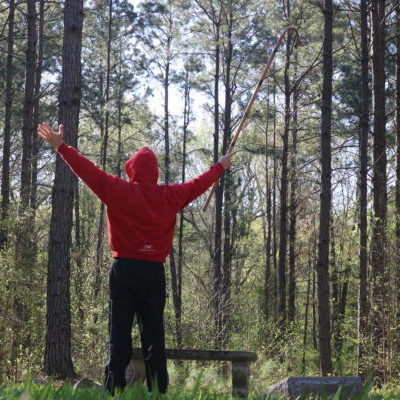
From March 10-31, 2019, I spent 21 days at a pastor’s retreat center without phone, internet, emails, or media. It was the “monk phase” of my sabbatical, spending time alone with the Lord, reading through the Bible, praying, journaling, writing, reflecting, recalibrating.
The Lord taught me a lot…about Himself…about myself.
I learned to see His glory throughout creation…throughout the day.
I learned how addicted I am to distractions…how long a day actually is…how hard it is to focus and to rest.
I learned how abundant and amazing His grace is to me each day.
Near the end of the 21 days, God gave me a unique “gift” that I am still trying to figure out.
Bell’s palsy.
Things started around day 10. I felt fluid deep in my left ear. As I chewed, my ear would pop on occasion. Every once in awhile, a deep piercing pain would hit my ear.
After a few days with these symptoms, I bought an ear irrigation kit and started taking an antihistamine/decongestant. I also started taking ibuprofen and aspirin periodically. The symptoms seemed to lessen so I didn’t worry about it. Living in a cabin among eighty acres of pine trees spitting out yellow pollen, I figured whatever I was dealing with was related to allergies.
On day 17, the ear pain was becoming more consistent and more noticeable. I was worried that I was developing an ear infection. Not wanting things to worsen, I decided to visit an urgent care facility that was 25 miles away. The doctor looked at my ear but didn’t see any signs of infection. She did recommend a full ear irrigation…which felt good and actually helped my ear to pop. She also recommended Flonase to help clear up any blockage in my Eustachian tubes. I bought the Flonase and started taking it that afternoon.
I would still get the piercing pain shooting through my ear at times but, for the most part, I seemed to feel better.
On day 19, I noticed a bad taste in my mouth. I thought it was the Flonase starting to work through my sinuses so I decided not to take it that day. I played nine holes of golf that afternoon and enjoyed spending the time out in the sun, walking the course, and hitting some golf balls. That evening during dinner, I noticed that the taste in my mouth was still bitter. I also noticed that the left side of my lip felt numb and that I kept dribbling water on myself as I drank.
I took a shower that night and noticed that I could not shut my left eye all the way. I kept getting soap in it and, when I would wipe it with the wash cloth, I could tell that it felt numb to some degree.
I thought I must be having an allergic reaction to something…possibly to some kind of weed or plant growing on the golf course. I took two antihistamine pills to make sure nothing more serious developed during the night…especially since I was far away from any kind of medical help.
I slept well and woke up thinking that I must be better.
But as I sat up in bed I noticed that the left side of my face still felt weird…almost like I had just gotten a novocaine shot at the dentist.
 I walked to the bathroom mirror and took my first look at my morning face. It was the worst I have ever seen…which is saying quite a lot! The whole left side of my face was practically paralyzed. I couldn’t shut my left eye all the way and I couldn’t move the left side of my mouth. My first thought was, “Am I having a stroke?!” That is not the best thought to have when you are 50 years old and sitting in a cabin by yourself in the middle of nowhere, Louisiana.
I didn’t quite know what to do. Besides the left side of my face not working, I could still function. I actually felt fine…though emotionally I wasn’t sure what I was feeling. Fear. Worry. Confusion. Dread. Is this something serious? Permanent? Life-altering?
I quickly got dressed and walked over to the main house of the retreat center. The older couple running the retreat center were at the breakfast table. They came to the door and noticed the concern…and strange look…on my face. Trying to get used to my half-working lips, I said, almost sounding like Daffy Duck, “Somethin’ is wrong with my fffface. I’m goin’ back to the doctor.”
Thankfully, they were familiar with Bell’s palsy and immediately said, “It looks like you have Bell’s palsy. My sister has had that several times. It should clear up after a few weeks but it would be good to go to the doctor.”
Bell’s palsy.
The term vaguely rang a bell in my mind (no pun intended). I couldn’t think of anyone I knew that had it but at least it didn’t sound as serious as a stroke. The idea that it should clear up in a few weeks was also comforting…though the operative word “should” was concerning at the same time.
I drove to the urgent care facility with a multitude of thoughts on my mind. What is Bell’s palsy? How did I get it? What is the prognosis? Will this have any long-term implications? Will this urgent care facility even be able to help?
When I walked into the urgent care facility, the doctor I saw a few days earlier saw me come in. As I began to talk to the receptionist, doing my best not to spray her with saliva as I talked, the doctor motioned to one of the nurses to get me into an examination room. Within a few minutes she came in and said, “As soon as I saw you come in, I could tell you had Bell’s palsy. It is not uncommon and it explains the ear pain you had a few days ago. That is sometimes how it starts. I am going to put you on a high dose of steroids and an antiviral medication. It should clear up in a few weeks.”
There was that word “should” again.
I asked, “Is there a chance that it doesn’t clear up?”
She said, “Most people return to normal function in two weeks. For some it takes a few months to get full function back. There are a few rare occasions where there is permanent damage to the facial nerve but I don’t think that will be your case.”
That was comforting…though the idea of a “rare case” with permanent damage lingered in my mind…especially when you are a pastor who speaks and teaches and interacts with people regularly.
I picked up the medicines from the pharmacy and took my first dosage as soon as I got back to my car. I wanted to make sure to do everything I could to protect my facial nerve and help it heal quickly.
Before that day, I couldn’t have even told you that I had a facial nerve. It was nothing I had ever thought about. I had no idea that a facial nerve running underneath your ear controlled the function of one half of your face…and when that facial nerve is irritated or compressed in some way then you no longer have the ability to raise your eyebrow, close your eye all the way, wrinkle your nose, smile, or move half of your lips.
I bought eye drops to keep my eye lubricated. I also bought an eye patch to wear at night since I couldn’t close my eye all the way.
The vision in my left eye is blurry.
The taste in my mouth is a little weird.
My left ear is super-sensitive to loud sounds.
I have to hold my left lip up while I drink in order to prevent dribbling. I have to pry my lips open on the left side if I am taking a big bite of food. It is hard to clear food from the left side of my mouth so I mainly chew on the right side. I find myself biting my left lip if I chew too fast since I guess it doesn’t have enough strength or sense to move out of the way.
Saying the letter “P” or “F” is difficult.
I can’t drink out of a straw because my lips can’t make a tight seal.
I can’t swish water in my mouth without it spewing everywhere.
My smile is crazy crooked. And I talk out of one side of my mouth…literally not figuratively.
Those are the symptoms of Bell’s palsy as I have experienced it.
Today is the two week mark.
The function of my face is returning. I can shut my left eye fairly tight though I still tend to get soap in it when I take a shower or wash my face. My lips are starting to function better. I speak better. I dribble less. I can almost raise my eyebrow and wrinkle my nose like the right side of my face.
I am thankful for my left facial nerve…and that it is starting to work again.
Have you ever thanked God for your facial nerves? Like most things in the body, we take them for granted until they stop functioning properly. We take so much for granted every day.
But the questions that linger in my mind are “why did I get Bell’s palsy?” and “why did I get it right at the end of my monk retreat?” Was there a message in the timing? Did God want me to learn something as I returned back to normal life, back to ministry?
The first lesson that comes to mind is…Don’t get too worried about your appearance because God can paralyze half your face whenever He wants to. It is hard to worry about your looks or your image or your appearance when half your face suddenly stops working.
But I think there is a bigger lesson to be learned. Our image is so tied to our face. There is a reason that social media’s giant is called “Facebook.” Our face is our identity to some degree. When we show pictures of ourselves, it is usually of our face. Who would want to have a whole social media profile on “Feetbook” or “Back-of-the-head-book”?
We put a lot of stock in our image…in our face.
Social media has only amplified and magnified that reality.
And it is killing us.
How much of our anxiety…worry…anger…angst…depression…is related to our perceived image before others?
When we are driven by our image…how we appear to others…how we are seen by others…then we miss the substance of life.
It is interesting that in Isaiah’s prophecy of the coming Suffering Servant, he describes a Man whose “visage”…His appearance…was “marred more than any man” (52:14). Isaiah goes on to say:
He has no form or comeliness;
And when we see Him,
There is no beauty that we should desire Him.
He is despised and rejected by men,
A Man of sorrows and acquainted with grief.
And we hid, as it were, our faces from Him;
He was despised, and we did not esteem Him (Isaiah 53:2b-3).
There is a reason that in all four Gospels we are never given a physical description of Jesus. In our modern culture, that would be the first thing that we would describe. But in God’s Word, it is not the focus…it is not even a concern.
Man looks at the outward appearance but the LORD looks at the heart (1 Samuel 16:7b).
God sees us for who we are. He sees past the outward flesh to the inward heart. He sees our secret thoughts, our fears, our doubts, our struggles, our motives. He sees the substance of who we are…not the image that we work so hard to portray.
And He loves us…at a level that we cannot fathom.
His Son proved that by taking on this human flesh…without any physical beauty or majesty…and dying in our place.
So that we could live for things more important than image.
So that we could find the life that is truly life.
Even with a crooked smile and a half paralyzed face.